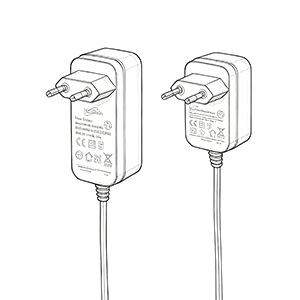
Power adapters are ubiquitous in our daily lives. Electronic products inevitably suffer damage over time, and power adapters are no exception. So, what are the common signs of a faulty power adapter? How can you tell if it's broken? Furthermore, why do non-original adapters keep burning out? This is generally caused by an overloaded circuit or a mismatch between the selected adapter and the device's electrical requirements. Let's briefly outline the common symptoms of a damaged power adapter.
Excessive Output Voltage
Excessive output voltage usually stems from issues in the voltage regulation sampling and control circuits. In the DC output, the closed-loop control system consists of components like sampling resistors, error sampling amplifiers (such as TL431), optocouplers, and power control chips. A failure in any of these parts can cause the output voltage to rise. If the fuse is intact but there is no output voltage, it indicates that the switching power supply has either failed to start or has entered a protection state. The first step is to check the startup voltage value at the startup pin of the power control chip. If there is no startup voltage or it is too low, check the external components connected to the startup pin and the startup resistor for leakage. If the power control chip is functioning normally, the fault can be quickly identified through the above monitoring. If there is a startup voltage, measure whether there is a high/low level transition at the output terminal of the control chip at the moment of startup. If there is no transition, it indicates a damaged control chip, faulty peripheral oscillator circuit components, or a malfunction in the protection circuit. You can troubleshoot by replacing the control chip and checking peripheral components one by one. If there is a transition, it is mostly due to a defect or damage to the switching transistor.
Insufficient Output Voltage
The following are the main causes of low output voltage:
a. Short-circuit faults in the switching power supply load (especially short circuits or poor performance in the DC/DC converter). In this case, first disconnect all loads from the switching power supply circuit to determine if the fault lies within the power supply circuit or the load circuit. If the voltage output returns to normal after disconnecting the load, the load is too heavy; if it remains abnormal, the switching power supply circuit is at fault.
b. Failure of the filter capacitor or rectifier diode at the output voltage terminal, which can be determined via substitution.
c. Degraded performance of the switching transistor, preventing it from conducting properly, which increases the internal resistance of the power supply and reduces its load capacity.
d. A defective switching transformer, which not only causes a drop in output voltage but also results in insufficient excitation for the switching transistor, thereby damaging it.
e. Poor quality 300V filter capacitors, resulting in poor load-carrying capability of the power supply; the output voltage drops as soon as a load is connected.
Circuit Line Faults
Circuit line faults include damaged power cords preventing power-on, oxidation at contact ports leading to poor contact, etc. Focus on checking whether the input and output lines are conducting electricity. If it is a line fault, it can be resolved by replacing the power cord.
Blown or Exploded Fuse
Mainly check the rectifier bridge, various diodes, switching transistors, and the large filter capacitor on the 300V line. A blown or blackened fuse may also be caused by issues in the anti-interference circuit. It is particularly worth noting that when a fuse blows due to a breakdown of the switching transistor, the power control chip and current-sensing resistor are often burned out as well. Thermistors are also easily burned out along with the fuse.
Fuse Blowing
Generally, a blown fuse indicates a problem with the internal circuitry of the power supply. Since the power supply operates under high voltage and high current conditions, fluctuations and surges in the grid voltage can cause a momentary surge in current within the power supply, leading to a blown fuse. Focus on checking the rectifier diodes at the power input end, the high-voltage filter electrolytic capacitors, and the inverter power switching transistors to see if these components are punctured, open-circuited, or damaged. If the fuse is indeed blown, you should first visually inspect the components on the circuit board to see if any appear burnt or if there is electrolyte leakage. If none of these conditions are found, use a multimeter to measure whether the switching transistor has a breakdown or short circuit.
Intact Fuse, No Output Voltage
An intact fuse with no output voltage indicates that the switching power supply has not started or has entered a protection state. The first step is to check the startup voltage value at the startup pin of the power control chip. If there is no startup voltage or it is too low, check the external components connected to the startup pin and the startup resistor for leakage. If the power control chip is functioning normally, the fault can be quickly identified through the above monitoring. If there is a startup voltage, measure whether there is a high/low level transition at the output terminal of the control chip at the moment of startup. If there is no transition, it indicates a damaged control chip, faulty peripheral oscillator circuit components, or a malfunction in the protection circuit. You can troubleshoot by replacing the control chip and checking peripheral components one by one. If there is a transition, it is mostly due to a defect or damage to the switching transistor.
No DC Voltage Output or Unstable Voltage Output
If the fuse is intact but there is no DC voltage output at any stage under load, this is mainly caused by the following: open or short circuits within the power supply, failures in the over-voltage or over-current protection circuits, the oscillator circuit failing to work, excessive power load, breakdown of rectifier diodes in the high-frequency rectification and filtering circuit, or leakage in filter capacitors. After using a multimeter to measure secondary components and ruling out breakdown of the high-frequency rectifier diode or a short circuit in the load, if the output is still zero, it can be confirmed that there is a fault in the control circuit of the power supply.
Poor Power Load Capacity
Poor power load capacity is a common failure, typically occurring in older power supplies or those that have been in operation for a long time. The main reasons are aging components, unstable operation of the switching transistor, and inadequate heat dissipation. Focus on checking whether the voltage regulator diode is overheating or leaking, and if the rectifier diodes or high-voltage filter capacitors are damaged.
If we have a good understanding of the principles behind power adapters, we can troubleshoot based on the causes introduced above when damage occurs. After identifying the cause, professionals can proceed with repairs. However, if you are not a professional, it is recommended to simply purchase a replacement if your power adapter is damaged.

Add WeChat

Official Account